Interview with Khabab Ahmed on the Situation in Sudan
“I think you saw what the Sudanese people did in 2018. They are aware of everything. And they know what’s good for them. I’m very sure that the Sudanese people will achieve what they want through protesting or any other means.”
Last December we talked to Khabab Ahmed, co-organizer of a demonstration in solidarity with the Sudanese people, about the situation in Sudan, foreign interference, and the question of what is to be done.
We published several articles on Sudan over the last few months; you can find them here on our website, if you want to read our position!
Do you want to tell us a bit about yourself?
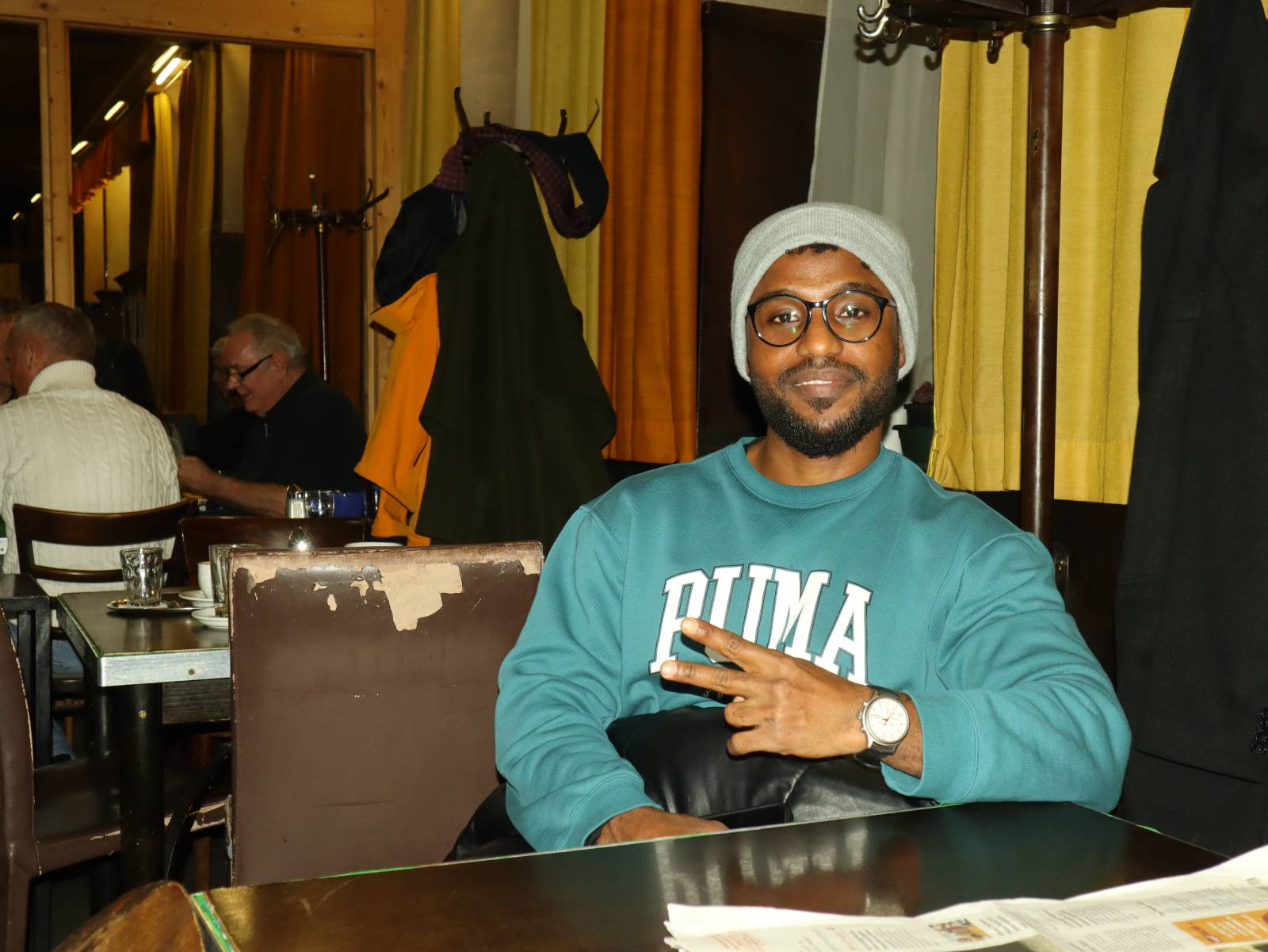
Khabab: My name is Khabab Ahmed. I’m a Sudanese who came to Austria three years ago to do my master’s program at the Technical University in Vienna, in Telecommunication Engineering.
Can you tell us a bit about how the situation in Sudan developed into what it is today?
Khabab: What’s going on in Sudan is very complicated, and it’s been going on since the revolution in 2018. I would say the revolution was successful because they overthrew Omar al-Bashir, the previous dictator, who had been ruling since 1989. After the revolution, there was a Transitional Government under Prime Minister Abdallah Hamdok, which was supposed to be partly civilian-led, but that did not end up happening.
In 2021, the Rapid Support Forces (RSF) and Sudanese Armed Forces (SAF) carried out a military coup. Their alliance quickly turned into a struggle for power. This is how the war started. Now, there are different countries involved. Saudi Arabia, Egypt, and Turkey support the SAF, while the United Arab Emirates (UAE) is involved with the RSF. Their interests mostly involve control over Sudan’s resources, but also access to the Red Sea and control over the Middle East in general.
The RSF’s leader, [Mohammed Hamdan Dagalo,] “Hemedti,” was established by al-Bashir to protect him. And now we are trying to show the world that what’s going on in Sudan is not a civil war. Because so many people really think that it’s just Sudanese people fighting each other. However, that’s not the thing. If the Emirates weren’t behind the RSF, I think this war would have done in a few months.
The UAE supplies the RSF with weapons through neighbouring countries such as Chad, Djibouti, and Libya. This will keep on going, and the only people who are really affected are the civilian people. When the war started, so many people fled the country. They went to Egypt, Ethiopia, and Kenya. There are refugee camps in West Sudan, in Kordofan, in Darfur, and the people there are dying.
I have family who is living in Khartoum right now. They refused to leave, and, luckily, they are safe. But still, there is a huge lack of supplies and necessities. And the people who are in the West have been most affected, because they are closest to the disputes.
That’s why it is so important for us to keep protesting and showing the world that the Emirates are complicit. We want to boycott and put pressure on them. And perhaps they will stop sending weapons to the RSF militia.
But how do you put pressure on the UAE? Because boycotting the UAE is not easy for us to do as individuals, especially because not going there or not investing in gold is a demand that only affects the elite, anyway. So, what we were wondering is: What can we do in Austria?
Khabab: The key is consistency. If we keep protesting and showing the world what’s going on, it will work eventually. Because I remember people having no idea what was going on in Palestine until the movement put pressure on governments in Europe. Now, people are a lot more aware. If we do the same, it will work eventually.
Do you think the military is an alternative to the RSF? Because in the end, they also helped defeat the revolution.
For us, as the loyal Sudanese people, the common sense is to support the army because the army protects us and the country. The RSF is not loyal to the country; their loyalty is to money. That’s why we are supporting the Sudanese Army. And after this war is finished, our first aim is a civilian government.
The RSF has been killing African tribes in West Sudan. And unfortunately, we have some people here in Austria who are supporting them.
Why do you think people support the militia?
Khabab: Hemedti is from a specific tribe. Some people have more loyalty to the tribes than to the country. And there is a big divide in [the Sudanese diaspora in] Austria, we are not really united. 25% of these people are supporting the militia. They even support the Emirates. So they’re just blind. They don’t know what’s going on; they’re just insisting on supporting them because they are from the same tribe.
That probably also makes it harder to mobilize if people are divided.
Khabab: Absolutely. That’s why we decided to do the protest. We started to communicate through our social media apps – WhatsApp and Telegram. We did it, and we are gonna keep doing it.
Was this an initiative of the youth in the diaspora?
Khabab: Yes. It was my friends‘ and my initiative to propose the protest to the group, and we also have some friends who are living in Innsbruck. They also did the protest a week before our protest.
How did you mobilize for the protest?
Khabab: First, we informed everyone in the community. Then, when everyone knew about it, we started contacting other communities, like the Syrian, Yemeni, and other countries that have been affected by the UAE.
What would you say are the main demands that you want to put forward in your demonstration? What are the key takeaways that people should know?
Khabab: The main thing people should know is that what’s happening in Sudan is not a civil war. They have to know it’s fueled by the United Arab Emirates. And what’s going on is because of them.
The second thing is that we need to support the Sudanese people in the refugee camps. We have an organization here [in Austria], it’s called FAAL. I think it was founded two years ago. They have been collecting and then sending the funds to Sudan to support the people in the refugee camps.
I know some friends who lost their family members, or family members are missing. Also, friends of mine have been killed. I was just lucky not to be there, but it’s crazy. That’s why we can’t sit down and remain silent.
Over 10 million people have been displaced, and over two million are starving. It really is unimaginable.
Do you have an idea of why international media don’t report on it?
Khabab: It’s really hard to understand why there is not enough coverage. I fail to understand exactly why the international media are not really focusing on what’s going on, even though it’s really horrifying.
But I’m very optimistic. Because I’ve been seeing what the Sudanese people are doing in the UK, in Canada, in different European countries. They are really doing a great job with protesting. They show the people that this is not a civil war, and it’s still going on. In the UK specifically, Sudanese people have been protesting in front of the Manchester City football stadium, because their president is also the vice president of the Emirates. He has been taking care of the military support and sending weapons to Sudan. That’s why Sudanese people are protesting in front of the stadium. They are doing a really great job.
I understand that you say that the priority is to just get rid of the RSF. But the military also killed a lot of people at anti-military junta protests in 2021, no? As far as we understand, they’re also backed by a lot of international powers, like Russia and China, who funded both sides, and maybe even the UAE.
Khabab: About Russia – the country itself is not involved. They wanted to build a military base at the port, close to the Red Sea. And there is a private military company called Wagner that has been supporting the RSF. The UAE also hires people from Wagner Group, from Colombia, Chad, Niger, Syria, and the Central African Republic.
And about China – they sell weapons to everyone, and I’m sure they sell them to the UAE as well. The UAE sends the weapons to the RSF. But the Chinese government should stop selling weapons to the UAE. The European Union and the United States should do the same. Putting pressure on them is the only way to stop the war.
The first thing that would have to happen now is to stop arms shipments. To stop funding the RSF.
Khabab: Exactly. Because as long as the funding is going on, the war is not going to end. Because the technology [the UAE is providing] is incredibly developed. That’s why they’ve been defeating the army. [And the RSF,] they are stealing everything. When they were in Khartoum, they stole everything. People lost everything. Their properties. [The RSF] even attacked some civilians‘ buildings. They’re even forcing kids, 14-15 years old, to fight with them. It’s crazy what they’ve been doing.
You said that supporting the army is the priority to get rid of the RSF. On the other hand, the army is also supported by big imperialist powers that also have their own interests. How do you imagine the transition from the junta to something more civilian-led after the RSF is gone?
Khabab: I think you saw what the Sudanese people did in 2018. People are not stupid anymore. They are aware of everything. And they know what’s good for them. I’m very sure that the Sudanese people will achieve what they want through protesting or any other means. Eventually, we are going to have an elected civilian government.
We read about the resistance committees during the revolution. Do you know how they’re doing now, if they’re still existing?
Khabab: Yes, they did a really great job during the revolutions. Now, they are mostly focused on helping people. They provide medical care and humanitarian support. We also use a hashtag on the internet, where people can support and get informed.
I was really fascinated when I read about how people organized themselves during the revolution.
Khabab: I was very sad not to be a part of it, because I wasn’t living there, you know? But I was supporting them through social media, and I have some friends who’ve been in the neighborhood committees.
This is why I’m thinking so much about the question of how you can transfer the power to the people and not have it be with the militia or the army.
Khabab: If people unite, they can achieve anything they want – that’s what they did in 2018, and we can do it again.
But I feel like they need to be able to defend themselves.
Khabab: Exactly. I mean, the army should actually be with the people.
But thinking about this ruling, they did not actually stand with them. I mean, from what I know, al-Burhan had some connections to China before, and I read that he also owns mines in Sudan. So, to me, it looked like a conflict of interest between the chief of the army, the chief general, and the rest of the country.
Khabab: Yes, al-Burhan also worked with the previous government. Once this war is finished, he will be out of the army and out of the picture. But right now, it’s his work to get rid of the RSF and the Emirates. But I believe the Emiratis are nice. I got to know some, but the thing is, they cannot say anything. Living there and saying anything against the government is very dangerous. I’m sure some people are against what’s going on, but they are helpless. They cannot do anything about it.
But the Emirates stole everything from us – the copper, electricity wires, everything. The Emirates should pay for this. And I mean, the Sudanese gold should belong to Sudan.
And to the Sudanese people.
Khabab: I mean, yes, how could you have such an amount of gold without having a single mine in your own country? All our resources should be to Sudanese people.